For a long time, readiness in the DIB meant something fairly specific: get your documentation in order, close out your open items, and be prepared for the day the assessor shows up. Readiness was something you achieved right before assessment day, then stopped thinking about until the next one rolled around.
This point-in-time validation model made sense in the past. Today, though, the nature of cyberattacks in the DIB means that assessment-readiness isn't enough. Infrastructure changes constantly. Identities multiply faster than anyone can track them, especially across contractors, suppliers, and service accounts. The attack surface is ever-expanding.
The solution to the problem is continuous readiness, a.k.a. operational resilience.
What Does Operational Resilience Actually Mean?
Operational resilience is defined in various ways across various industries. In our books, it refers to the ability of an organization to keep operating securely during and despite operational change. In practice, that can look like:
- Sustaining secure behavior continuously, not just configuring it once and walking away
- Maintaining governance so that oversight survives staff turnover, reorgs, and new tooling
- Preserving visibility despite changing environments (versus losing track of what's happening mid-migration)
- Adapting securely as environments evolve, rather than bolting on security after the fact
Notice that none of these are individual controls. In fact, you can have every required control implemented and still lack the operational muscle to keep them functioning when your environment shifts.
Identity lifecycle governance is one of the biggest places where a company's operational resilience gets tested. Contractors leave, projects end, roles change, and access often remains, sometimes until an attacker or an auditor finds it. The longer that gap goes unnoticed, the harder it becomes to avoid exposure or reconstruct who should have actually had access.
Continuous monitoring, change management, and operational telemetry all face the same test. Can you maintain visibility during a migration, an acquisition, or a tooling swap without a gap opening up?
Supplier governance is another key place where operational resilience matters, since third-party access is consistently where security principles break down. Meanwhile, threat detection and response coordination is where it all gets stress-tested in real time.
How Does Rev. 3 Fit Into the Operational Resilience Conversation?
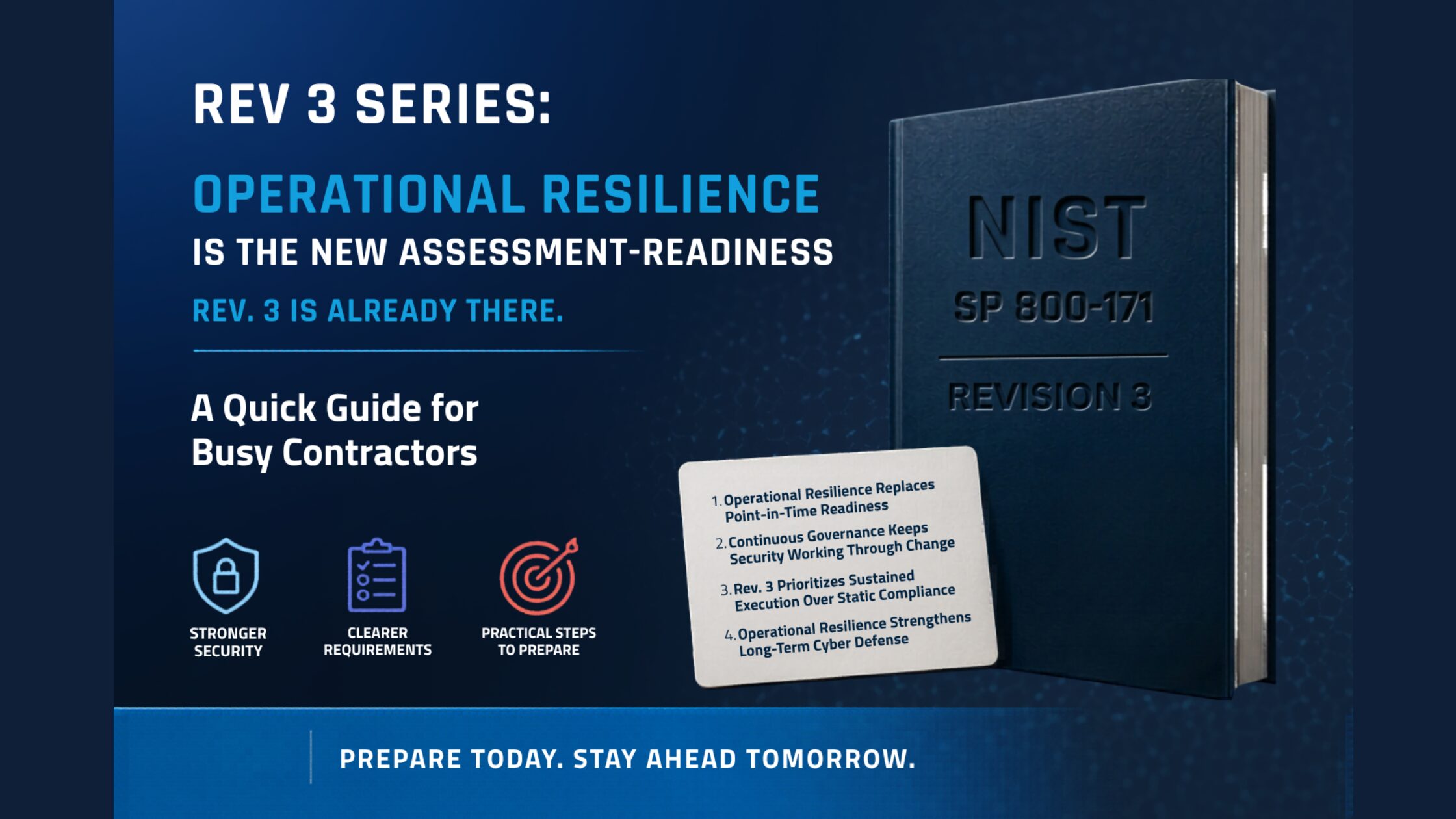
It doesn't take a close read to see that NIST SP 800-171 Rev. 3 is emphasizing these same principles: continuity over point-in-time snapshots, ongoing governance over set-and-forget implementation, and resilience over static validation. You can see it in the structure of the framework itself; the expanded Planning and Supply Chain Risk Management families are pushing organizations to think about sustained oversight rather than one-time implementation.
Beyond that, Rev. 3's growing emphasis on organization-defined parameters (ODPs) means there's no one-size-fits-all approach; each ODP has to be thoughtfully configured and periodically revisited as the environment changes. The goal is for organizations to stop copying baselines that don't make sense in their environment and then forgetting them after the assessor leaves. Instead, the expectation is that your business can demonstrate that each control is there for a reason and has been operating consistently under real conditions.
Plus, if you're a policy fiend like us, you can download the whole Rev 3 publication.
Review the DoD's proposed Rev. 3 ODP values here.
More simply put? Rev. 3 is emphasizing intentional security decisions and sustained execution, a.k.a. operational resilience.
Bottom Line: What Does This Mean for the DIB?
Adversaries keep getting better at finding exactly the kind of gaps that open up during change, supply chain exposure keeps growing, and continuous monitoring is becoming table stakes. Primes and CMMC assessors are responding to this ever-growing threat landscape by expecting DIB contractors to mature their operations.
Getting to a state of operational resilience is easier said than done. Luckily, you don't have to get there alone. Sentinel Blue works with DIB contractors to close the gaps, turning point-in-time compliance into the kind of sustained operational discipline that Rev. 3 is asking for.